

If you ask any family in K.V.Kuppam what is most important to them they will invariably answer ‘Money’. Not because they want expensive holidays or to buy the latest fashion or computer games but because money gives security (there are no state hand-outs for the unemployed) and most important of all it gives their children access to a good education. Indian families believe that the best way out of poverty is through education. If families can afford it they will pay for extra tuition throughout a child’s education in order to prepare them for exams each term. Class sizes are large, children are taught by rote and they are not able to ask questions during a lesson. Additional tuition is essential for them to pass end of term exams.
Even if a young person successfully studies for a degree there is still no guarantee of employment as the competition is very fierce. In some professions such as teaching, people have to wait, sometimes several years, until their name comes to the top of a list and they are then offered a job. Where they start on the list depends on several factors including the quality of their degree and the caste they belong to. There is positive discrimination for people from the Scheduled Castes and this does cause some difficulties for graduates from other castes. Young people from professional families in India know they must attain very high marks in order to justify their private education and earn a good living. This puts them under tremendous pressure.

Most children in K.V.Kuppam are now able to attend school until at least 10th Standard, when they are 15 years old, although there are still some children, usually girls, from lower income families who do leave sooner because of financial pressures. Many villagers value education so highly they will even take on debts which are difficult to pay back in order to give their children a chance of a better education.
Tamil is the language of Tamil Nadu and children are mostly taught in this language in government schools but it is not spoken in other parts of India. Parents recognise that the best way their children can achieve in school and improve their employment prospects is to be taught in English. This is called English Medium. It is available in government and private schools but parents must pay a fee and many villagers cannot afford this.
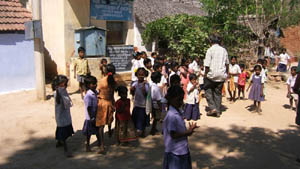
Many families are now choosing to give their daughters, as well as their sons, the best education they can afford and a small minority of girls even marry and carry on with their education if their husband is willing to support this.

Government incentives such as free bicycles and books have also helped to persuade parents to keep children at school beyond the age of 15 years.
Find out more:
 Friends of Vellore UK