
Every year, hundreds of families bring their children to CMC Vellore for treatment and care. Many families struggle to meet medical and related expenses to travel to Vellore from all over India. Friends of Vellore UK are sending CMC £10,000 annually to enable a paediatric subsidy fund.
This fund supports 10 children each year who are admitted to CMC Vellore for treatment or surgery. The fund is for children from poor families who would benefit from a one-off intervention with a high likelihood of a positive outcome. Below is the story of one patient who benefitted:
Baby Pratap
Extremely distraught parents bought their two-month-old baby to the outpatient department. The father and mother, both new parents, were completely exhausted. Pratap never seemed to want to feed and if he did, he would start coughing and appeared to be choking on the milk. He weighed just 2.9kg and had not gained any weight since his birth.
Pratap was given antibiotics for a chest infection by the paediatrician at Kolkata and was advised to wait for a few months to see if his feeding improved. An ENT surgeon in his local village had investigated his throat and reassured his parents that he was normal.
In CMC’s paediatric surgery outpatient department, the doctor was quite concerned about his constant coughing. He arranged for Pratap to have a barium swallow test; the child was given some solution to track the progress from his food pipe to the stomach to identify causes of choking. This revealed a small connection between the trachea and the oesophagus, called an H type tracheoesophageal fistula, which is extremely rare. To prevent him from aspirating on his breast milk any further, CMC passed a feeding tube to his stomach and taught mum how to feed him through this until they had a chance to prepare him and the family for a major operation.
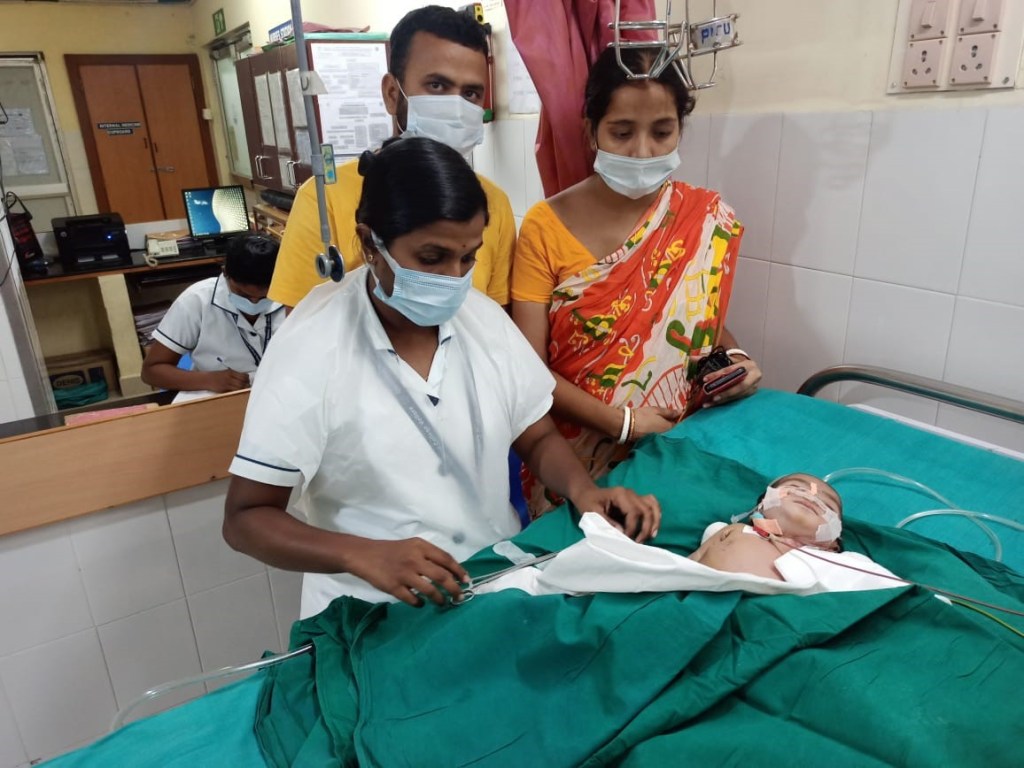
The father is a sorter in a fish shop and had raised a few thousand rupees from friends and family to come to Vellore for an opinion. They were not prepared for an operation and less so a major surgical undertaking in their little child as an emergency. His own father passed away many years ago and he also takes care of his elderly mother (who accompanied them to Vellore to help take care of the child). The father requested that they take baby Pratap home as they were unable to afford the operation that could divide the fistula – he felt it was better that the child died peacefully than the entire family fell into debt.
CMC however assured him that they would arrange for funds for his baby as the treatment, though complex, was a single and curative procedure. They admitted Pratap to a ward, and soon after into the Intensive Care Unit as he was struggling with pneumonia from all the aspirations. His haemoglobin was one third of what a normal new-born should be due to his malnutrition.
When he stabilised, Pratap was taken to the operating theatre where he underwent a bronchoscopy to visualise the location of the abnormal connection between his food pipe and trachea (windpipe). It was found to be deep in his chest close to where the lungs bud away from the trachea. Though this is a lower location than usual, CMC decided to approach his repair with a method they felt would be least invasive. They used a camera (thoracoscopy) into his chest and 3mm laparoscopy instruments to find and tie off the fistula. Pratap tolerated the operation; he recovered well and was discharged.
A year later, Pratap was brought to CMC for his follow up. Much to the treating doctor’s amazement, his father expressed his desire to contribute some of his savings to help families like his in CMC. He met the Development Office team and gave his donation. This is the kind of impact your gifts have on CMC’s patients. Donate today and see your gift bless many more!
Friends of Vellore UK helped fund the appointment of an Occupational Therapist in the Department of Paediatric Surgery at CMC, focusing on two vulnerable groups of children: those recovering from major burns and those born with myelomeningocele (a type of spina bifida). Each year, the department treats around 80 young burn patients and 70 children with myelomeningocele, many of them newborns. Both conditions require not only surgery and medical care, but also long-term support for the children and their families.
Through engaging therapies and practical guidance, the Occupational Therapist plays a vital role in recovery and rehabilitation. For children with burns, this means easing their hospital stay and supporting their transition home. For those with myelomeningocele, therapy includes exercises, coping strategies, and continence management—helping them achieve developmental milestones, gain confidence, and integrate into school and community life. This holistic care transforms lives, turning painful or isolating experiences into opportunities for healing and hope.
 Friends of Vellore UK